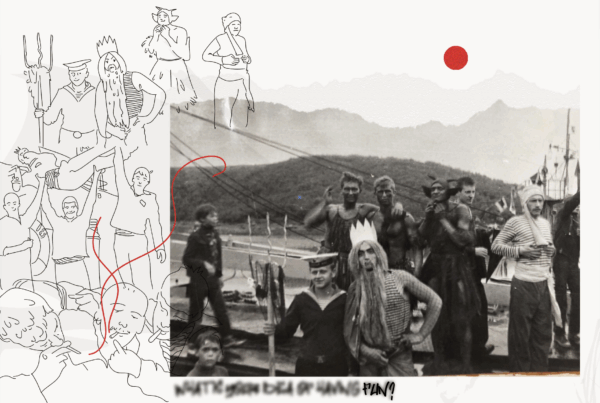
In the spring of 1987, a rickety lift in the Artists’ Union of Armenia rattled up to the actual third floor, depositing a handful of twenty-somethings who would turn the building’s attic into a feverish laboratory of late-Soviet dissent. Within months the space—swiftly nicknamed “Yerort Hartak” (3rd Floor)—was staging ad-hoc performances lit by slide projectors and fuelled by Coca-Cola iconography smuggled from Moscow kiosks. What looked like a student prank soon became Armenia’s answer to perestroika: not a policy but a happening.
To grasp the shock such antics produced, recall the cultural climate of 1985-88. While Gorbachev loosened the screws in Moscow, Yerevan’s official art still revolved around Socialist Realism, and curators clung to a “national-in-form, socialist-in-content” dogma first enforced in the 1930s. Armenian modernists of the 1960s had opened fissures, but it took the glasnost moment to widen them into exits. 3rd Floor’s founders—Arman Grigoryan, Sev (Hendrik Khachatryan), Karen Andreasian and others—declared that modernity meant “autonomous, future-oriented, liberating practice,” a stance closer to Dada than to the neo-avant-gardes of Eastern Europe.
Their manifesto was simple: art must escape both artisan craft and state hierarchy. Borrowing the term Hamasteghtsakan—“crossover” or “collectively created art”—they abolished genre boundaries, invited non-artists to co-author works, and rebranded the gallery itself as a three-dimensional canvas. Like China’s Political Pop painters, they mixed Soviet symbols with Western consumer logos; but the effect in Yerevan was even more jarring because such imagery was still scarce on the street.
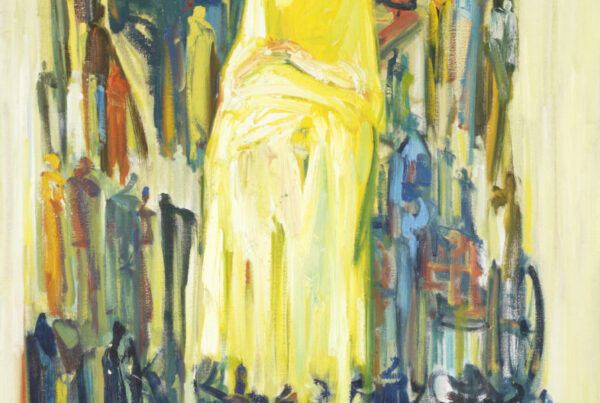
Critic Nazareth Karoyan traced the group’s lineage back to medieval manuscripts and forward to Italian Transavanguardia: hybrid, ornamental, defiantly provincial-and-cosmopolitan at once. Angela Harutyunyan added that 3rd Floor “mirrored the changing world of perestroika”—utopian, iconoclastic, yet oddly rooted in tradition. That paradox helps explain why Sev’s Object (1987)—a bare wooden frame draped with plastic sheeting—could scandalise a generation trained to equate mastery with brushwork.
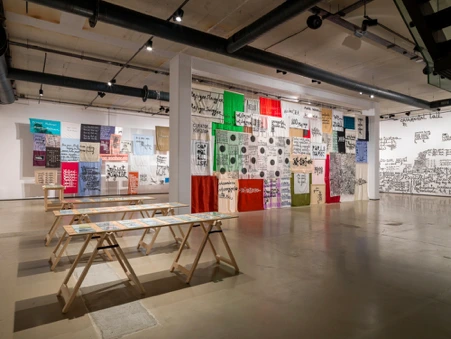
Sev’s gesture was only the prelude. The legendary “3rd Floor ±” exhibition of 1990 turned the loft into a fun-house of painted mannequins, Xerox collages and on-the-spot graffiti, welcoming anyone who felt like adding a mark. Photographs from the show (figs. 72-74) reveal a riot of colour that anticipated the selfie museums of today, yet its politics were deadly serious: by refusing to rank high and low culture, the collective implicitly refused the Soviet ranking of citizens.
By 1994, however, the utopian mood curdled. Independence had arrived, but so had hyper-inflation and rolling blackouts. A new formation—ACT—stepped into the vacuum, swapping 3rd Floor’s romanticism for hard-edged institutional critique. If 3rd Floor protested from the outside, ACT protested from within the artwork: Davit Kareyan’s Art Referendum (1995) replaced the ballot box of fledgling democracy with an art object, exposing participation itself as theatrical.
ACT’s marches down Mashtots Avenue or interventions in the half-finished Mars robotics factory dissected the gap between neoliberal dreams and post-Soviet realities. Their materials dematerialised: split fire extinguishers, sliced coffee tins, piles of bureaucratic forms. The divorce of idea from object echoed an Armenian economy that suddenly traded goods for IOUs.
The 1990s also spawned Armenia’s contemporary-art infrastructure. NPAK (later HayArt) occupied the Modern Art Museum’s “Barrels” annex, while curators such as Sonia Balassanian forged Armenia’s first Venice-Biennale pavilion. Yet the scene fractured into two camps: “institutional art,” exemplified by Arman Grigoryan and Kareyan, and “institutional critique,” waged by Andreasian, Samvel Baghdassaryan and the ferociously nomadic Geo-Cunst-Expedition.
By decade’s end a strange reversal occurred: the conceptualists picked up brushes again, spiked with Pop sarcasm. Grigoryan’s Armenican Dream (1999) splashed Coca-Cola reds across a folk motif, while his canvas Civic Values advertised itself “For Sale: $50,” mocking the absent art market. “Form is contemporary,” argued Kareyan, “content is the past”—a new twist on the Soviet slogan he grew up with.
Fast-forward to the 2000s and you can still spot 3rd Floor DNA on Yerevan’s walls: Saga Saghatelian’s neon-bright mural Love is Electric (2016) or the stencil slogans that bloom around Kond. These pieces practice what Harutyunyan once called “progressive nostalgia”—they quote perestroika’s optimism precisely to measure today’s frustrations.
Seen in hindsight, 3rd Floor was not a footnote but a hinge: it pried open the Soviet frame so that ACT, NPAK and the current boom of NGOs, residencies and graffiti crews could step through. Its members asked whether anyone could be an artist; their descendants ask whether art can still change the terms of citizenship.
AMCA’s mission is to map that conversation as it spreads across decades and disciplines. Our upcoming digital archive will host interviews, photo-galleries and curriculum guides on 3rd Floor and ACT. Readers who possess posters, VHS footage or even half-remembered stories are invited to contribute. The revolution on the attic floor isn’t over; it has just moved online—join us there.